Learn how to tell pool evaporation from a leak in Central Florida, run a reliable bucket test, and know when water loss needs repair.
A dropping pool level in late-summer Central Florida does not automatically mean a leak. Sun, wind, warm water, splash-out, fountains, and screen-enclosure airflow all affect evaporation. The useful question is whether the pool loses more water than a small container exposed to the same weather. A controlled bucket test answers that without relying on a universal daily-loss number.
Direct answer: Turn off the autofill, stop swimming and adding water, place a bucket of pool water on a submerged step, and mark both levels. After 24 hours without heavy rain, compare the drops. If the pool falls farther than the water inside the bucket, abnormal water loss is likely and the pool should be inspected for a leak.
Key Takeaway
Measure the pool against its own weather, not a rule of thumb. A bucket test can confirm that the pool is losing water faster than evaporation, but it cannot locate the leak or prove which repair is needed.
Why Pool Evaporation Varies Across Central Florida
Evaporation is the change from liquid water to water vapor. It speeds up when the air is dry relative to the pool surface and when moving air carries humid air away. Water temperature, air temperature, direct sun, wind, shade, a screen enclosure, and active water features all change the result.
That is why a fixed claim such as "every Florida pool loses one-quarter inch per day" is not a dependable diagnosis. A screened pool in Lake Mary, an exposed pool in DeLand, and a shaded pool in Deltona can behave differently on the same afternoon. Heavy use adds splash-out, while afternoon storms may hide loss by refilling the pool.
The U.S. Department of Energy explains that evaporation is the largest source of energy loss from pools and that covers reduce evaporation. The same principle helps with diagnosis: if weather and pool operation change, expected water loss changes too.
Before testing, rule out two simple explanations. Check that backwash or waste valves are fully closed and look for an autofill that runs continuously. An autofill can conceal a pool leak while steadily increasing water use.
How to Run a Reliable Pool Bucket Test
The City of Tampa's water-conservation guidance recommends a bucket comparison because the bucket and pool experience the same evaporation conditions. Use this practical version:
- Choose a stable 24-hour window. Avoid heavy rain, high winds, parties, cleaning, or adding water. If a downpour changes either level, restart the test.
- Turn off the autofill. Confirm that no hose, overflow, spa spillway, or scheduled top-off will alter the measurement.
- Fill a clean bucket with pool water. Set it securely on a pool step so part of the bucket is submerged. Do not let it float or block circulation.
- Mark both starting levels. Mark the water inside the bucket. Mark the pool level on the bucket's exterior, tile line, or skimmer face.
- Operate the pool normally. Keep the usual pump schedule for the first test, but leave water features off unless they normally run every day.
- Compare after 24 hours. Measure each drop from its own mark. If both fell by about the same amount, evaporation is the likely explanation. If the pool fell farther, suspect a leak.
- Repeat once when results are close. A second clear-weather test reduces errors from wind, a loose mark, minor splash-out, or an unnoticed top-off.
Use the same ruler and record the result in inches, not gallons. The surface area of the pool determines how many gallons correspond to a measured drop, so a gallon estimate without accurate pool dimensions can mislead.
"A bucket test answers one question well: is the pool losing water faster than the weather can explain? It does not tell you to start breaking concrete."
- Dave Cole, Cole's Pool Service & More
What the Test Result Does and Does Not Tell You
| Result | What it suggests | Best next action |
|---|---|---|
| Pool and bucket drop equally | Evaporation is the likely cause | Monitor weekly and consider reducing water-feature run time or using a suitable cover |
| Pool drops farther than bucket | Abnormal water loss is likely | Repeat once, document the difference, then schedule diagnosis |
| Test is interrupted by rain or swimming | Result is unreliable | Reset the marks and choose another 24-hour window |
| Autofill ran during test | Leak may be masked | Turn it off and repeat |
| Water falls to one level, then stops | Leak may be near that elevation | Do not keep draining; photograph the level and arrange an inspection |
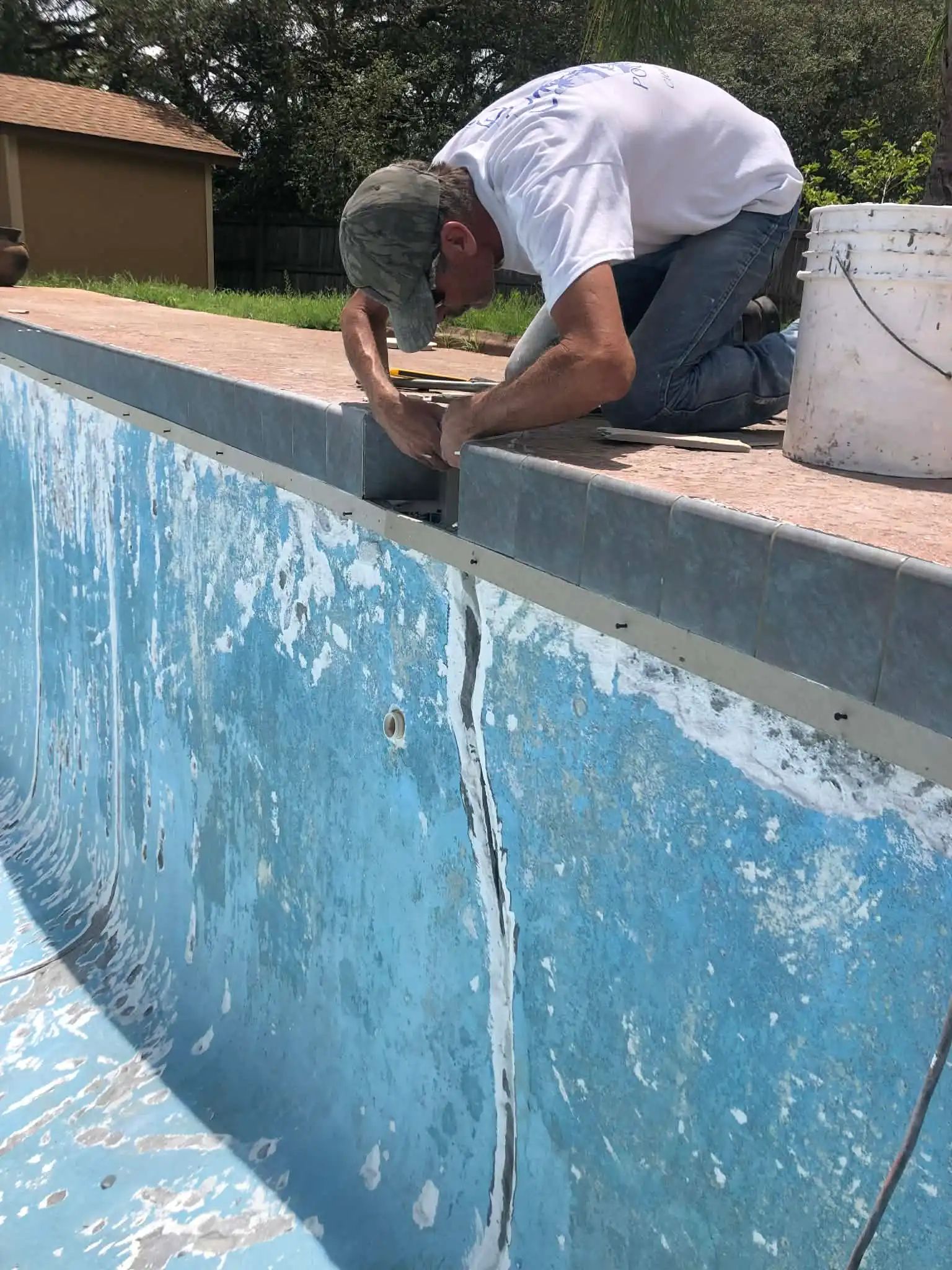
The test does not identify a failed skimmer throat, light niche, return fitting, shell crack, valve, filter, pump seal, or underground pipe. It also does not justify sealing a visible crack without checking whether that crack is cosmetic, active, or unrelated to the water loss.
Clues That Help Narrow the Inspection
Documenting when and where water appears helps a repair professional choose the right tests. Note these patterns without dismantling equipment:
- Wetness at the equipment pad: look for drips at the pump, filter, heater, valves, unions, and waste line while the system runs.
- Air under the pump lid or bubbles at returns: this may indicate a suction-side air entry or low pool level, but it does not prove an underground leak.
- Loss that changes with pump operation: tell the technician whether the difference appeared during the normal pump schedule. Pressure testing, not guesswork, isolates a plumbing line.
- Water stopping below the skimmer or at a fitting: photograph the exact level. Do not intentionally let the water fall far enough to expose the finish or leave the pump without adequate water.
- Soft soil, erosion, or lifted pavers: water may be moving below the deck even when no surface puddle appears.
- A constantly running autofill or unexplained water-use increase: shut off the autofill for testing and record the meter or utility alert if available.
Why Waiting Can Create More Than a Water Bill
Ongoing loss does more than require frequent top-offs. Fresh fill water changes pool chemistry, and repeated adjustments consume sanitizer and balancing products. Water escaping below a deck can also wash material from a paver base or keep surrounding soil saturated.
Low water creates an immediate equipment concern. If the level drops below the skimmer opening, the pump may pull air and lose prime. Do not continue operating a pump that cannot maintain a full water flow. Turn it off and arrange service rather than repeatedly restarting it.
Do not respond to unexplained water loss by adding extra chemicals. Test the water first, follow each product label, and never mix products. The CDC's pool chemical safety guidance advises keeping chemicals separate, dry, and in their original labeled containers.
What Homeowners Can Check Safely
You can complete the bucket test, photograph a fixed waterline, inspect visible equipment connections, empty skimmer baskets, and note whether the autofill or overflow is active. Those checks provide evidence without opening the circulation system.
Stop and call for qualified help when:
- The pump runs dry, loses prime, trips a breaker, or shows electrical damage
- Water or wet soil appears near electrical equipment
- The pool loses more water than the bucket in repeated tests
- Pavers settle, soil erodes, or a crack changes
- The water reaches the bottom of the skimmer opening
- The leak appears to involve an underground line, light niche, shell, or structural fitting
Avoid pouring leak sealers into the pool or using dye around a fitting while circulation or swimmers are present. Dye can be useful in controlled professional diagnosis, but movement from a return, cleaner, wind, or body in the water can create a false trail.

Pool Leak Questions Central Florida Homeowners Ask
How can I tell if my pool is leaking or evaporating?
Run a 24-hour bucket test with the autofill off and no swimming or added water. If the pool level drops farther than the water inside the bucket, the pool is probably losing water through a leak.
How long should I run a pool bucket test?
Twenty-four hours is usually enough for a useful comparison. Repeat the test during another stable weather window when the difference is small or rain, wind, splash-out, or equipment changes affected the result.
Should the pool pump be on or off during the bucket test?
Use the normal pump schedule for the first test so the pool behaves as it usually does. Record that schedule for the repair professional; do not run a second pump-off test if the water is already too low for safe operation or equipment condition is uncertain.
Can an autofill hide a pool leak?
Yes. An autofill can replace escaping water before the drop becomes visible, leaving continuous filling or increased water use as the main clue. Turn it off before measuring.
Does a bucket test locate the pool leak?
No. It compares pool loss with evaporation. Locating the source may require visual inspection, isolation of features, pressure testing of plumbing, or controlled dye and acoustic testing.
Why does my pool lose water only when the pump runs?
A change tied to pump operation is useful diagnostic evidence and can point toward a pressurized fitting, valve, waste line, filter, or return-side issue. It is not proof of a specific failed part, so document the pattern and have the system tested.
Confirm the Loss Before Choosing the Repair
Start with a clean 24-hour comparison, repeat it when conditions interfere, and save photos of the marks. If the pool loses more than the bucket, keep the water at a safe operating level only as directed and avoid guessing at the repair.
For related troubleshooting, review the pool equipment warning signs common in Florida, the DIY pool repair mistakes that cause bigger problems, and our Central Florida hurricane pool checklist.
Dave Cole
Dave Cole founded Cole's Pool Service & More in 2008 after completing his military service. Based in Central Florida, he holds Florida state contractor licensing and has personally overseen several hundred pool builds, renovations, repairs, and long-term maintenance accounts across Volusia, Seminole, Orange, and Lake counties. His writing draws directly from what he encounters in the field every week.
References
- 1.City of Tampa Water Department. (2026). How to check for leaks: Pool DIY leak test. https://www.tampa.gov/water/conservation/check-for-leaks
- 2.U.S. Department of Energy. (n.d.). Swimming pool covers. Energy Saver. https://www.energy.gov/energysaver/swimming-pool-covers
- 3.Centers for Disease Control and Prevention. (2025). Pool chemical safety. https://www.cdc.gov/healthy-swimming/toolkit/pool-chemical-safety.html