Identify green, mustard, and black pool algae in Florida, choose the right treatment, and prevent repeat blooms with smarter water care.
Florida pools fail the algae test faster than pools in any other state, and the cause is not cheap chemicals or inattentive owners. Year-round warm water, near-daily summer rainfall that introduces a continuous phosphate load, and UV intensity that can destroy 90 percent of a pool's free chlorine within two hours of direct sun create conditions where algae can establish in a window too short for reactive management to close. The more consequential misunderstanding, though, is that "algae" describes three biologically distinct organisms that behave differently, resist chlorine at different levels, and require different treatment approaches. Using an identical response to every bloom is the primary reason pools cycle through the same problem every few weeks without resolving it.
Identifying Which Type You Are Dealing With
Visual identification is straightforward once you know what each type looks like. Treatment selection starts here.
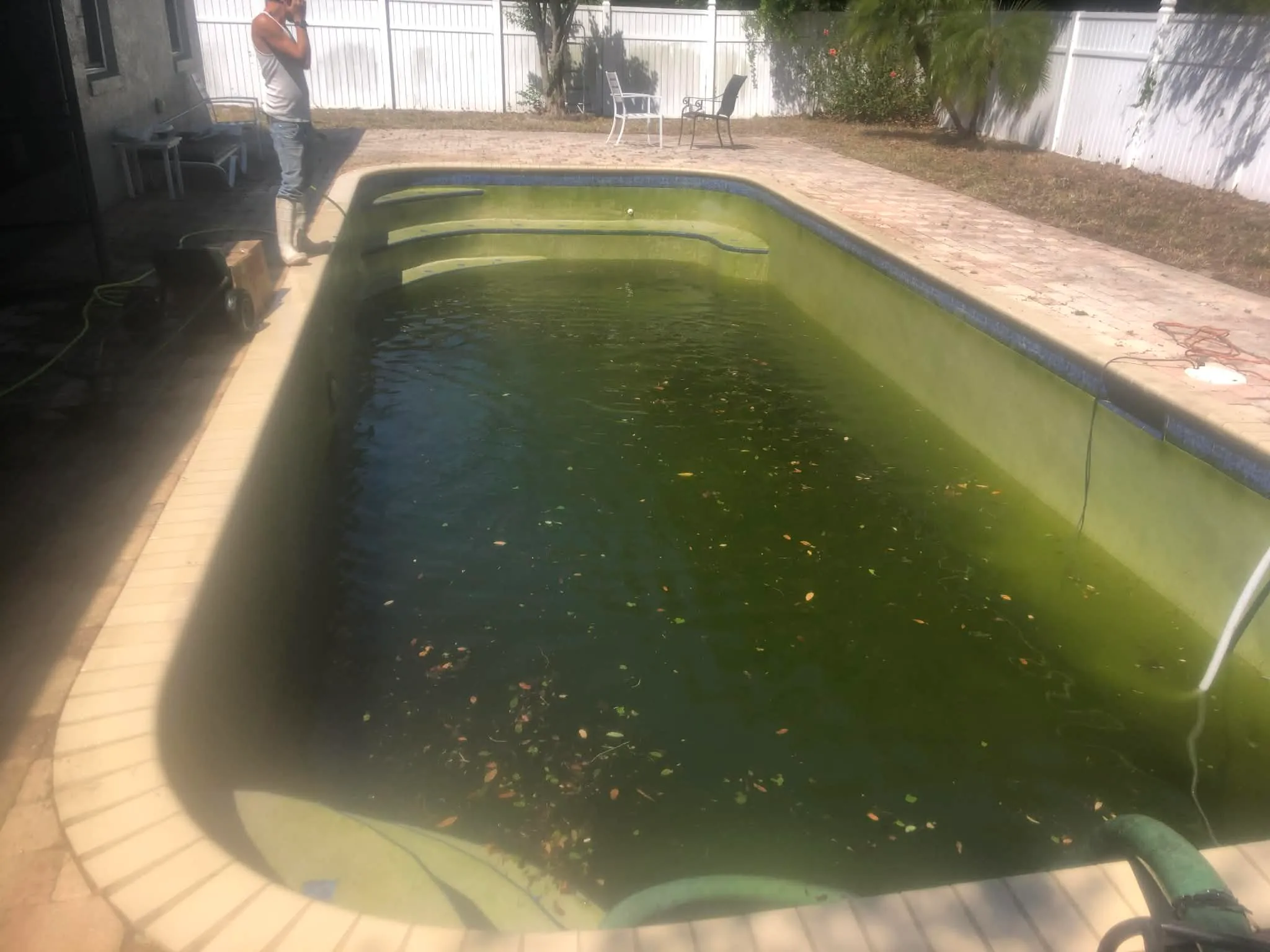
Green algae turns pool water visibly hazy or distinctly green and can turn a clear pool murky within 12 to 24 hours when conditions are right. Surfaces feel slippery when running your hand across them underwater. In early stages, the water may look slightly cloudy before it turns obviously green. Green algae is free-floating, which means it suspends throughout the water column rather than clinging primarily to surfaces.
Mustard algae appears as yellowish-green deposits along walls and the pool floor, usually concentrated in shaded areas on the side of the pool that receives the least direct sun. It brushes off easily when you run a brush across it, but returns within hours. This is the single most reliable identifying sign: green algae does not behave this way. Mustard algae is consistently misidentified as pollen, dirt, or sand on the pool floor, which leads to no chemical treatment at all and a growing infestation.
Black algae appears as small, firm, dark green or nearly black spots embedded in the plaster surface, typically in rough plaster, grout lines, crevices near fittings, and step edges. Unlike the other two types, it does not brush off and it does not disperse into the water. Running a brush across a black algae spot leaves it intact or removes only the surface layer temporarily while the organism remains established below. If you have dark spots on plaster that resist brushing, you are dealing with black algae, which is technically a cyanobacterium rather than a true algae and requires a fundamentally different treatment approach.

Treating Green Algae
Green algae is the most responsive to chlorine and the fastest to clear when treated correctly. The sequence matters as much as the product quantities.
- Test all five chemistry parameters before adding anything. Adjusting without a baseline reading is the fastest way to compound the problem.
- Adjust pH to 7.2 to 7.4 before shocking. At pH 8.0, roughly 80 percent of added chlorine is in its inactive form. The weekly maintenance post covers this adjustment sequence in detail. Getting pH right before shocking is not optional.
- Brush all surfaces thoroughly before adding shock. Brushing breaks up surface-clinging cells and suspends them in the water where the chlorine can reach them.
- Shock the pool to at least 30 ppm free chlorine. For a 10,000-gallon pool, this typically means 3 to 4 pounds of calcium hypochlorite (68 percent available chlorine). Standard single-pound shock doses are insufficient for an active bloom.
- Run the pump continuously, 24 hours a day, until the water clears. Circulation distributes the chlorine and moves water through the filter.
- Vacuum to waste once the water clears enough to see the bottom. Vacuuming to waste bypasses the filter and sends the dead algae out of the system entirely. Vacuuming to the filter pushes it into the filter media and risks blowing it back into the pool during backwash.
- Clean or backwash the filter after the pool clears. A filter that processed a bloom is holding significant organic load and will restrict flow and reduce water quality until it is cleaned.
A correctly treated green algae bloom in a pool with accurate chemistry typically clears within 24 to 72 hours.
Treating Mustard Algae
Mustard algae is chlorine-resistant. Standard shock doses that clear a green pool in two days may produce minimal results against mustard algae over a week. The treatment approach requires higher chlorine concentrations and one step that almost every DIY treatment misses.
Every piece of equipment that has been in the pool water must be treated simultaneously with the pool. Brushes, nets, vacuum hoses and heads, pool toys, and flotation devices carry mustard algae spores and reintroduce them to the pool within 24 hours of treatment if they are not sanitized at the same time. Placing all of it in the shallow end during the shock treatment is the standard approach. Swimwear worn in the pool should be laundered with a detergent wash before it is used again.
For the pool itself, shock to 30 ppm as with green algae, but plan for two to three treatment rounds spaced two days apart rather than a single treatment. Add an algaecide specifically labeled for mustard algae after each shock treatment once chlorine drops back below 5 ppm. Polymer-based or quaternary ammonium compounds labeled for mustard algae improve results significantly compared to shock alone. Continue brushing daily, as mustard algae establishes on surfaces more than it floats freely.
Treating Black Algae
Black algae forms a waxy, protective biofilm layer that acts as a physical barrier to chlorine. Shocking the pool without addressing this layer first sends the chlorine through the water column while the cyanobacterial colonies remain isolated beneath their coating, essentially untouched.
Physical disruption of each spot is required before chemical treatment will have any effect. Use a stainless steel brush, not nylon. Scrub each visible dark spot aggressively. On older or rougher plaster surfaces, this means working the brush into any pits or crevices where spots have established. The biofilm layer must be broken before chlorine can penetrate.
After brushing, rub a trichlor tablet (stabilized chlorine puck) directly on each scrubbed spot while the pool is not occupied. This applies a concentrated chlorine dose directly to the disrupted area. Then shock the pool to 30 ppm and run the pump for 24 hours.
Expect to repeat this full sequence every five to seven days for three to four treatment cycles. Black algae rarely clears in a single treatment. Spots that appear gone may have living root structures below the plaster surface that regenerate the visible portion within days.
Pools with old or heavily textured plaster surfaces are significantly more susceptible to black algae because the rough texture provides protected attachment points the organism can exploit. If black algae is a recurring annual problem, the underlying plaster condition is almost certainly contributing. The pool resurfacing guide covers when a surface has reached the point where treatment alone will not provide lasting results.
Phosphates: Why the Same Pool Keeps Getting Algae
A pool with correct chlorine levels does not develop algae in the absence of a nutrient source. Phosphates are that nutrient source, and Florida delivers them continuously. Every afternoon thunderstorm carries dissolved phosphates from runoff, pollen, and organic debris. Leaves decomposing in an uncovered skimmer basket release phosphates. Lawn fertilizer overspray reaching the pool area contributes additional load. In an enclosed pool (covered by a screen enclosure), this input is reduced substantially. In an open pool, it is ongoing all year.
When phosphate levels rise above 200 to 300 parts per billion, the pool is providing a nutrient environment where even a brief chlorine drop can trigger rapid algae growth. Owners who cannot understand why their chemistry looks correct on Tuesday but they have a bloom by Friday are often running high phosphates.
Standard test strips and most basic home test kits do not include a phosphate test. A separate phosphate test kit or a full water analysis through a pool supply store will show the level. If you have a pool that repeats algae blooms despite diligent chemistry management, phosphate testing should happen before the next treatment round.
Lanthanum-based phosphate removers clear phosphates effectively. Add the product with the pump running, run the pump for a full 24-hour cycle afterward, then clean or backwash the filter. The treatment creates a visible floc that the filter captures, and skipping the cleaning step after treatment returns that captured debris to the water.
"Most repeat algae calls I take involve one of two things: the homeowner treated green algae but actually had mustard algae, or they treated the pool but left every brush and net sitting on the deck untouched. The chemistry lesson matters less than the diagnosis."
- Dave Cole, Cole's Pool Service & More
Prevention Comes Down to Two Numbers
Preventing all three types follows the same foundation covered in the weekly maintenance routine: free chlorine consistently between 1.0 and 3.0 ppm and pH maintained at 7.2 to 7.6 so the chlorine that is present remains active. Those two numbers, held consistently, close the growth window before any of the three types can establish.
Adding monthly phosphate testing to that routine closes the nutritional pathway. An enclosed pool reduces the organic debris load, which is a measurable chemistry advantage beyond the obvious debris and insect benefits described in the screen enclosure guide. None of these steps eliminates the need for chemical management, but they reduce the conditions under which algae can establish despite correct management.
Dave Cole
Dave Cole founded Cole's Pool Service & More in 2008 after completing his military service. Based in Central Florida, he holds Florida state contractor licensing and has personally overseen several hundred pool builds, renovations, repairs, and long-term maintenance accounts across Volusia, Seminole, Orange, and Lake counties. His writing draws directly from what he encounters in the field every week.
References
- 1.Centers for Disease Control and Prevention. (2024). Healthy Swimming: Pool Chemical Safety. https://www.cdc.gov/healthy-swimming/
- 2.Association of Pool & Spa Professionals. (2023). ANSI/APSP-11 Water Quality Standard for Swimming Pools and Spas. https://www.apsp.org/
- 3.National Swimming Pool Foundation. (2024). Certified Pool Operator Handbook. https://www.nspf.org/