Before building a new pool in Central Florida, compare budget, site, permitting, equipment, safety, and maintenance decisions that shape the project.
Most Central Florida homeowners who call us for a pool build have already spent weeks looking at design photos and have a clear picture of what the finished pool should look like. What they have not worked through are the upstream decisions that determine whether that design is buildable on their lot, what it will actually cost, and whether the equipment underneath it will perform reliably in Florida's climate for the next 20 years. Those decisions do not happen during construction. They happen before the contract is signed, and the homeowners who have made them in advance consistently have smoother builds and fewer surprises.
Know What Your Lot Will and Will Not Allow
Before any design conversation is productive, a site evaluation needs to establish what is physically and legally possible on your property. Florida building code requires minimum setback distances from pool edges to property lines, structures, and easements. In most residential zones across Volusia, Seminole, Orange, and Lake counties, the pool shell must sit at least 5 feet from the property line and at least 10 feet from the primary structure. HOA restrictions in many communities add more conservative requirements on top of those minimums.
Beyond setbacks, three site factors frequently surprise first-time pool owners:
- Utility lines. Underground utilities must be located before excavation begins. A pool positioned over an easement or utility corridor may require re-routing that adds weeks and significant cost before a single yard of dirt is moved.
- Drainage. Florida's high water table and clay-heavy soils in portions of Volusia and Orange counties affect excavation depth and sometimes require engineered drainage solutions. Sites that pond water after heavy rain need additional assessment before a pool position is finalized.
- Tree proximity. Root systems from mature oaks and palms can compromise a pool shell over time. The general working rule is that the distance from the tree trunk to the pool edge should exceed the tree's projected height at maturity. Removing a large oak before construction adds cost upfront but eliminates a long-term structural liability.
Knowing these constraints before design begins prevents a situation where a homeowner commits to a layout the lot cannot support.
Gunite: The Right Choice for Custom Builds in Central Florida
Gunite is pneumatically applied concrete sprayed against a steel reinforcement framework. It can be built in any shape, depth, or configuration, which makes it the standard for custom residential pools in Central Florida. A gunite shell is permanent and resurfaced every 10 to 20 years depending on the finish material chosen. The build process runs 8 to 14 weeks from permit application to water fill. The interior surface is a porous material, which means water chemistry management is more consequential than it would be with a non-porous alternative. Maintaining proper calcium hardness, pH, and alkalinity is not optional on a gunite pool: it protects the shell surface directly and extends the life of the finish by years.
Sizing for Florida's Actual Usage Patterns
A pool sized for Florida's climate looks different from one sized for a northern market. In Central Florida, a pool is usable 10 to 11 months out of the year. That extended season means that sizing decisions carry more consequence than they would if the pool went unused from November through April.
The most common sizing mistake is underestimating how the pool will actually be used once it is in the ground. A family with children uses a pool differently than a couple who primarily swims laps or entertains. Practical sizing benchmarks for a Florida residential pool:
- Minimum depth of 3.5 feet in the shallow end for comfortable standing use by adults
- Minimum depth of 5 to 5.5 feet in the deep end for general deep-end use and jumping entry
- A length of at least 28 to 30 feet if occasional lap swimming is a priority for anyone in the household
- Pool width of at least 12 to 14 feet to allow two swimmers to move past each other without contact
Pools that look adequate on paper at 12 by 24 feet consistently feel small after the first summer season. A 15 by 30 or 16 by 32 foot pool costs meaningfully more at the time of construction, but the difference in daily usability across 25 years of ownership is significant. If the budget is tight, it is generally a better trade to build a larger pool with a simpler finish than a smaller pool with premium features.
Sun Shelves, Spas, and Water Features: Real Cost Ranges
Water features are the decisions that most affect a build's final cost, and they are also the decisions most frequently underestimated at the planning stage. Florida's year-round outdoor lifestyle makes each of these more justifiable than it would be in a northern climate, but each one carries a real number.
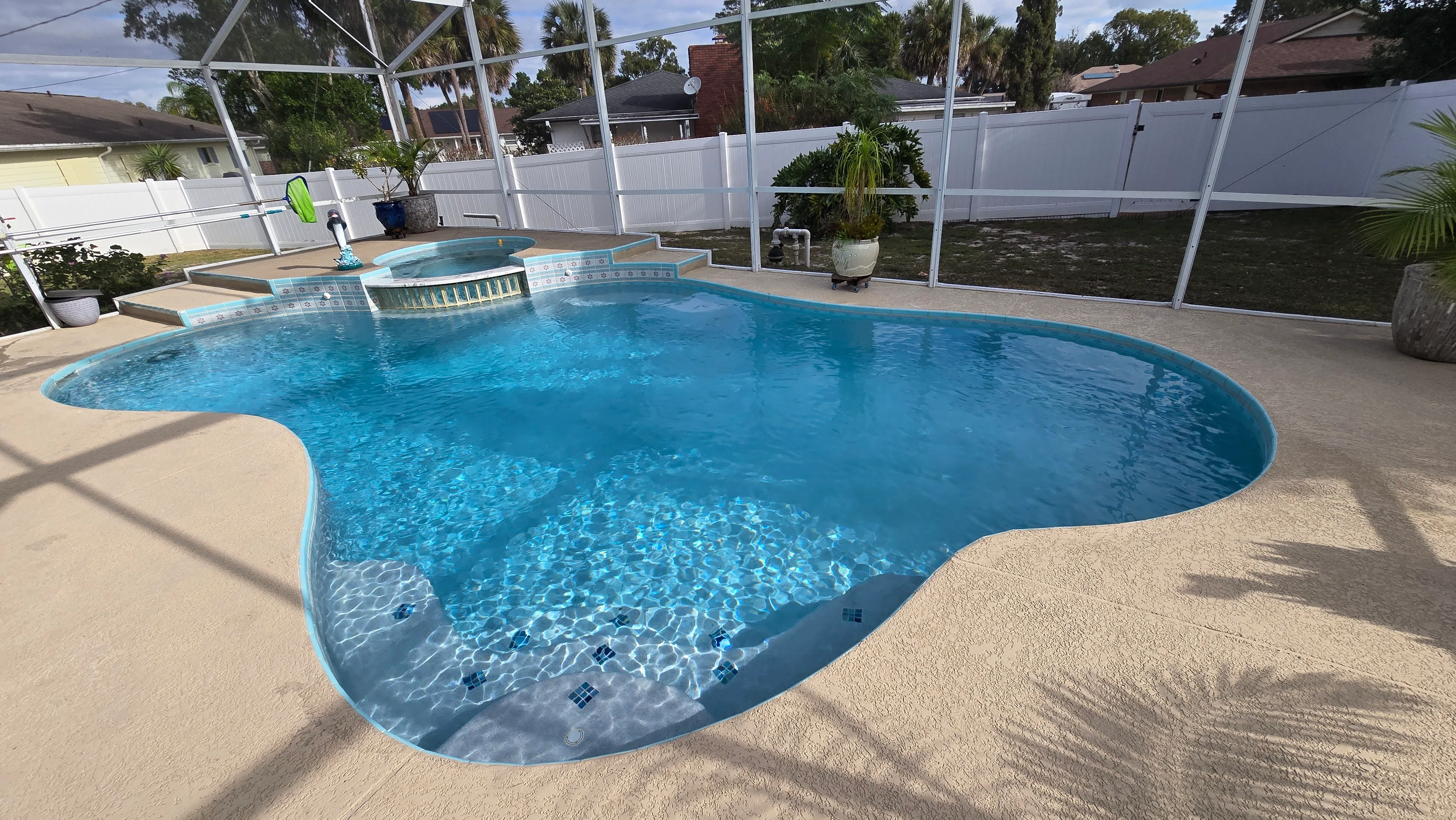
- Sun shelf (tanning ledge). A shallow, flat area 6 to 12 inches deep integrated into the shallow end. Useful for lounging chairs, small children's play, and as a visual design element. Adds $3,000 to $6,000 to a gunite build depending on size and configuration.
- Attached spa. An in-ground spa integrated with the pool's plumbing and heating system. Winter months in Central Florida are mild but cool enough that a heated spa sees regular use from October through March. Adds $8,000 to $15,000 above pool base cost depending on size and the heating source specified.
- Water features (waterfalls, deck jets, scuppers). Primarily aesthetic, though the sound and movement of water is a meaningful backyard quality-of-life factor. A basic waterfall or two to three deck jets adds $2,000 to $5,000. Elaborate grotto configurations or multi-element systems add substantially more and require additional pump capacity.
- LED lighting. Color-changing LED systems for the pool shell and surrounding water features add $800 to $2,500 depending on fixture count and controller type. In Florida where evening pool use is routine for 8 to 9 months of the year, lighting is among the most consistently used features on a finished pool.
The trap to avoid is specifying features during the sales conversation without understanding which ones will actually be used versus which ones sound appealing in the showroom. A spa that will be used regularly is worth every dollar. A grotto waterfall that the family stops using after the first season is not.
Equipment Decisions Made During the Build Last 15 to 20 Years
Pool equipment is specified and installed as part of the construction contract, but many homeowners treat it as a secondary detail. It is not. Equipment choices affect the pool's lifetime operating cost more than nearly any other single decision in the project, and upgrading equipment after the pool is finished costs two to three times more than specifying it correctly at the build stage.
Variable speed pump. Florida law, effective 2021, requires new pool installations to use variable speed or variable flow pumps. This is not optional. Variable speed pumps reduce energy consumption by 50 to 70 percent compared to single-speed models and extend equipment life because they operate at lower speeds for the majority of their running hours. Specify a pump with a programmable controller that allows custom speed and filtration schedules rather than a basic model with preset speeds.
Salt chlorine generation vs. traditional chlorine. A salt system uses a chlorinator cell to generate chlorine from dissolved sodium chloride. Upfront cost adds $800 to $2,500 to the build. Ongoing chemical costs drop substantially, and the water feel is softer and less irritating for most swimmers. The chlorinator cell requires replacement every 3 to 7 years. For a pool used year-round in Florida, a salt system typically pays for itself within 3 to 5 years in reduced chemical costs alone.
Automation system. An automation controller allows pump speed, lighting, heating, and water features to be managed through a smartphone app or wall panel. Adding automation during the build is a straightforward wiring decision. Adding it after the fact requires rewiring through finished decking and equipment pads and costs significantly more. If smart home integration or remote monitoring matters, specify it in the original contract.
Heating. A heat pump heater is the most cost-effective heating method for Florida's ambient conditions. Gas heaters raise water temperature faster but cost 3 to 4 times more per month to operate than a heat pump running under comparable conditions. For a spa that needs to reach 102 degrees quickly on demand, a gas heater or hybrid configuration makes sense. For maintaining pool temperature across Florida's cooler months, a properly sized heat pump is the right specification.
"The equipment package is where homeowners most consistently under-specify on the front end and pay the price over the life of the pool. A variable speed pump, a salt system, and an automation controller add a few thousand dollars to a build. The alternative is paying more in electricity and chemicals every month for 20 years."
- Dave Cole, Cole's Pool Service & More
How to Verify a Pool Contractor Before You Sign
Florida requires pool contractors to hold a state-issued Swimming Pool/Spa Contractor license through the Florida Department of Business and Professional Regulation. This license requires passing a state exam covering pool construction, applicable building codes, and business practices. Verifying the license before signing anything is not a courtesy step: unlicensed pool construction voids the homeowner's property insurance coverage for that structure in most policies, and defects on an unlicensed build have no legal remedy through the contractor licensing board.
Verify any contractor's license at myfloridalicense.com before the first meeting. Look for a CPC (Certified Pool Contractor) designation alongside an active status. If the license is expired, suspended, or not found, walk away regardless of the price offered.
Beyond licensing, three questions reveal whether a contractor has genuine experience building in Central Florida:
- Which permit offices does your work run through, and what is the current processing time? A contractor who builds regularly in Volusia County knows that different municipalities have different timelines and has existing relationships with local inspectors.
- Who performs the physical work? Some contractors are primarily salespeople who subcontract every trade phase. A contractor who employs a consistent crew for gunite application, plumbing, and electrical produces more consistent results than one who assembles a different subcontractor team for each job.
- Can you provide three references from builds completed in the past 12 months? Recent references reflect current performance. References from three years ago may describe a company operating at a different scale or with different personnel.
Once you have selected a contractor and the permit is submitted, the construction process itself follows a predictable sequence of phases. For a full breakdown of what happens from permit approval through water fill, see our post on what to expect during a custom pool build in Central Florida.
Dave Cole
Dave Cole founded Cole's Pool Service & More in 2008 after completing his military service. Based in Central Florida, he holds Florida state contractor licensing and has personally overseen several hundred pool builds, renovations, repairs, and long-term maintenance accounts across Volusia, Seminole, Orange, and Lake counties. His writing draws directly from what he encounters in the field every week.
References
- 1.Florida Department of Business and Professional Regulation. (2024). Verify a License. DBPR. https://www.myfloridalicense.com/wl11.asp
- 2.Florida Building Commission. (2023). Florida Building Code, Residential. Florida Department of Business and Professional Regulation. https://floridabuilding.org/
- 3.Association of Pool & Spa Professionals. (2023). ANSI/APSP-5 American National Standard for Residential Inground Swimming Pools. https://www.apsp.org/
- 4.University of Florida Institute of Food and Agricultural Sciences. (2022). Swimming Pool Management in Florida. UF/IFAS Extension. https://edis.ifas.ufl.edu/