A local guide to weekly pool service in Deltona and DeBary, including chemistry, brushing, equipment checks, and algae prevention.
Deltona and DeBary pools do not get a quiet season. Central Florida heat, afternoon thunderstorms, screen enclosure debris, and year-round swimming keep the water under pressure every month of the year. The difference between a pool that stays clear and one that turns green is usually not one miracle product. It is a weekly service routine that tests the right chemistry, cleans the surfaces algae uses first, and catches equipment problems before they become repair calls.
Why Deltona and DeBary Pools Need Consistent Weekly Service
Most homeowners searching for "pool service near me" are not looking for a chemistry lecture. They want the water clear, the pool safe to use, and the equipment protected. In West Volusia, that takes more than dropping tabs in a floater and skimming the top once in a while.
Deltona lots often have more shade, pine needles, oak leaves, and organic debris than newer open subdivisions. DeBary pools see the same heat load, plus heavy seasonal use from families who swim after work and on weekends. Both areas get fast weather swings. A pool can test fine on Monday, take two inches of rain on Wednesday, then show low chlorine and early algae by Friday.
A good weekly visit should handle three jobs at the same time:
- Water balance: keeping sanitizer, pH, alkalinity, calcium, and stabilizer in working range.
- Physical cleaning: removing the dirt, leaves, pollen, and biofilm that chemistry alone does not remove.
- Equipment review: checking the pump, filter, baskets, valves, cleaner, and visible plumbing while the system is running.
If one of those three is skipped for a few weeks, the pool starts costing more. Low sanitizer turns into algae treatment. Poor brushing turns into stains. Dirty baskets and rising filter pressure turn into flow problems. A regular route visit is cheaper than recovering a pool after it gets away from you.
What a Proper Weekly Pool Service Visit Should Include
Weekly pool service should follow a repeatable order. The order matters because each step gives the technician information before product is added or equipment is adjusted.
- Visual inspection: the visit should start with a look at water clarity, surface debris, tile line buildup, water level, stains, algae growth, and anything unusual around the equipment pad.
- Basket cleaning: skimmer baskets and pump baskets should be emptied before the system is judged. A clogged basket can make a healthy pump look weak.
- Chemistry testing: free chlorine, pH, alkalinity, calcium hardness, and cyanuric acid should be tracked. Salt pools also need salt level and cell condition checked on a routine schedule.
- Brushing: steps, benches, corners, tile lines, and shaded walls need brushing because those areas grow algae first in Florida water.
- Skimming and vacuuming: leaves and dirt should come out before they break down into the water and feed chlorine demand.
- Filter and pressure check: the pressure gauge tells whether flow is restricted, the filter is loading up, or a cleaning cycle may be due.
- Equipment check: the pump should prime cleanly, run without grinding, and move water through the returns with steady flow.
- Chemical adjustment: products should be added after testing, not by habit.
The CDC advises residential pool owners to check disinfectant and pH regularly because those are the first defenses against swimming-related illness. Florida's public pool rules also keep pH and sanitizer ranges front and center because water quality fails quickly when either one drifts. Home pools are not inspected the same way public pools are, but the chemistry principles do not change.
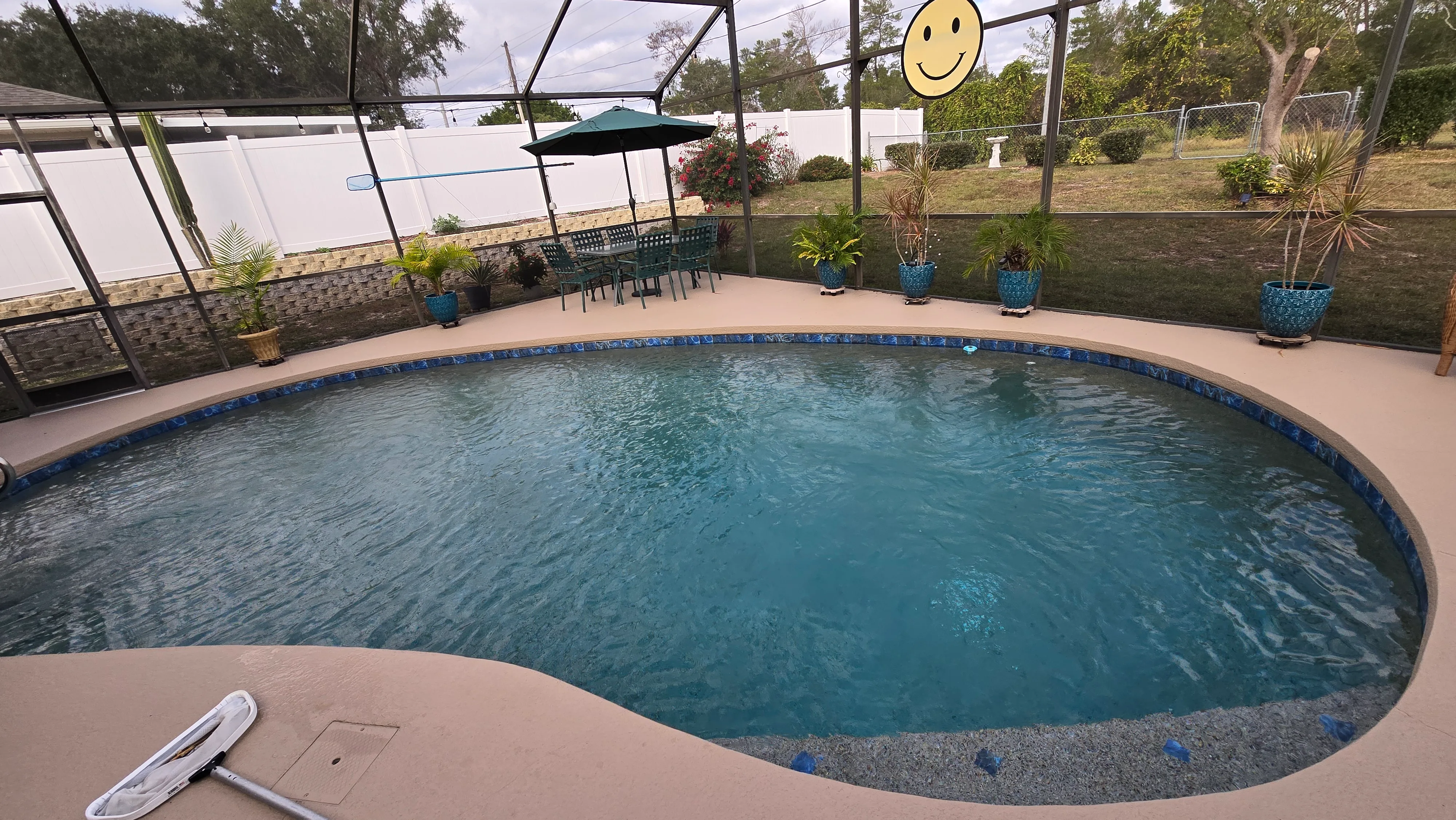
The Chemistry Numbers That Matter Most
Pool owners hear a lot of product names, but the same core numbers decide whether the water stays stable. I care less about which bottle is being sold and more about whether the pool is testing in a range that makes sense for Central Florida.
For most residential chlorine pools, the weekly service target should focus on these readings:
- Free chlorine: enough active sanitizer to handle Florida heat, rain, and swimmer load between visits.
- pH: generally in the 7.2 to 7.8 range, with the exact target adjusted based on the pool finish and current conditions.
- Total alkalinity: stable enough to keep pH from bouncing every few days.
- Calcium hardness: high enough to protect plaster and aggregate finishes, but not so high that scale becomes a constant fight.
- Cyanuric acid: enough stabilizer to protect chlorine from sun loss, but not so much that chlorine becomes sluggish.
The stabilizer number is a common trouble spot in Deltona and DeBary because many pools rely on tablets. Tablets are convenient, but they add stabilizer over time. When cyanuric acid climbs too high, the pool can show chlorine on a test strip and still struggle with algae. The fix is not always more tabs. Sometimes the fix is dilution, liquid chlorine, better brushing, and a more disciplined treatment plan.
Salt pools need the same attention. A salt system makes chlorine, but it does not balance pH, brush walls, empty baskets, clean filters, or diagnose weak flow. In Florida, salt cells also collect scale faster when pH and calcium are left alone. A salt pool still needs weekly service.
Why Brushing Prevents Algae Better Than Extra Chemicals
Algae starts on surfaces before it colors the whole pool. It likes shaded walls, steps, corners, behind ladders, around light niches, under spillways, and along the tile line. Those are exactly the places that do not get enough circulation from the return jets.
Brushing breaks the film that algae uses to hold onto the surface. Once that film is disturbed, chlorine can do its job. Skipping brushing and adding more chemical is the long way around the problem. It may make the water look better for a day, but the same spots come back because the source was never removed.
In Central Florida, I want brushing built into the normal service visit, not saved for when the pool already looks bad. The difference is visible after four to six weeks. Pools that are brushed consistently have fewer recurring green corners, fewer cloudy recovery weeks, and less staining around steps and benches.
"Most green pools are not mystery chemistry problems. They are missed routine problems. Test the water, brush the surfaces, keep the filter moving, and you prevent most of the expensive calls."
- Dave Cole, Cole's Pool Service & More
Equipment Checks That Save Repair Money
A weekly maintenance visit should catch small equipment changes early. The person cleaning the pool is usually the first one to hear a bearing getting loud, see an air leak in the pump lid, notice low return flow, or spot a pressure gauge climbing past normal.
These are the checks I want done before a problem becomes urgent:
- Pump prime: the pump should fill with water and stay full while running. Bubbles under the lid can point to suction-side air leaks.
- Filter pressure: a pressure reading 8 to 10 psi above the clean starting pressure usually means the filter needs attention.
- Return flow: weak flow from the returns can mean a clogged basket, dirty filter, valve issue, cleaner restriction, or failing pump.
- Timer and automation: the system should run long enough each day to turn over and skim the pool properly.
- Visible leaks: wet pads, dripping unions, and damp equipment bases should be noted early.
- Cleaner performance: a suction or robotic cleaner that stops covering the pool can leave debris in the same areas every week.
If a maintenance company only looks at the water and never looks at the pad, they are missing half the job. A pump, filter, or valve issue can make a perfectly balanced pool turn cloudy because the water is not moving and filtering correctly. That is why our pool maintenance service and pool repair service overlap in the field. The route visit often finds the repair before the homeowner has to discover it the hard way.
When Weekly Service Is Better Than DIY Pool Care
DIY pool care can work when the owner tests consistently, brushes every week, keeps records, and understands what each adjustment changes. Many homeowners start strong, then work, travel, storms, and family schedules interrupt the routine. In Florida, a two-week gap can be enough for algae to take hold.
Weekly service is usually the better fit when any of these are true:
- The pool turns green more than once a year.
- The owner is adding products without testing all five major readings.
- The pool has a screen enclosure that traps pollen, leaves, and humidity.
- The equipment pad has a variable-speed pump, salt system, heater, automation, or older plumbing that needs experienced eyes.
- The pool is used by children, guests, tenants, or short-term rental visitors.
- The owner wants clear water without turning Saturday morning into a chemistry project.
This does not mean the homeowner should ignore the pool between visits. After big storms, heavy swim days, or visible debris, a quick skim and a basic chlorine and pH check still helps. Weekly service gives the pool a professional baseline. Smart in-between attention keeps that baseline from getting hit too hard by weather and use.
How to Choose a Local Pool Service Company
The best pool service company is not always the cheapest quote. A low monthly number does not help if the visit is rushed, chemistry is guessed, filters are ignored, or communication disappears when the pool turns cloudy.
Ask these questions before hiring a pool service in Deltona, DeBary, Orange City, Sanford, or Lake Mary:
- What readings are tested during a normal visit?
- Is brushing included every week or only when algae appears?
- How often are filters cleaned, and is that included or separate?
- Will the technician report equipment concerns before they fail?
- Who do I contact if the water changes between visits?
- Do you service both chlorine and salt pools?
- Are repairs handled in house or referred out?
A good answer should be specific. "We keep it blue" is not specific. "We test sanitizer, pH, alkalinity, calcium, and stabilizer, brush the surfaces, empty baskets, inspect equipment, and document repair concerns" is specific. That is the level of detail homeowners should expect when they are paying for weekly care.
The Bottom Line for Pool Care Near Deltona and DeBary
Clear water is the result of rhythm. Test the water before adding products. Brush the pool before algae becomes visible. Keep baskets and filters clean enough for steady flow. Watch the equipment pad every week. Adjust the plan after storms, parties, pollen drops, and seasonal heat changes.
If you are comparing local options after searching for "pool care near me" or "pool service Deltona," look for a company that treats maintenance as prevention, not just cleanup. The goal is not to rescue the pool over and over. The goal is to keep it swim-ready so the family can use it without guessing what the water needs.
Dave Cole
Dave Cole founded Cole's Pool Service & More in 2008 after completing his military service. Based in Central Florida, he holds Florida state contractor licensing and has personally overseen several hundred pool builds, renovations, repairs, and long-term maintenance accounts across Volusia, Seminole, Orange, and Lake counties. His writing draws directly from what he encounters in the field every week.
References
- 1.Centers for Disease Control and Prevention. (2024). Home pool and hot tub water treatment and testing. Healthy Swimming. https://www.cdc.gov/healthy-swimming/about/home-pool-and-hot-tub-water-treatment-and-testing.html
- 2.Florida Administrative Code. (2023). Rule 64E-9.004, Operational requirements. https://flrules.elaws.us/fac/64E-9.004
- 3.Florida Department of Health. (2026). Public swimming pools. https://www.floridahealth.gov/healthy-environments/swimming-pools/index.html